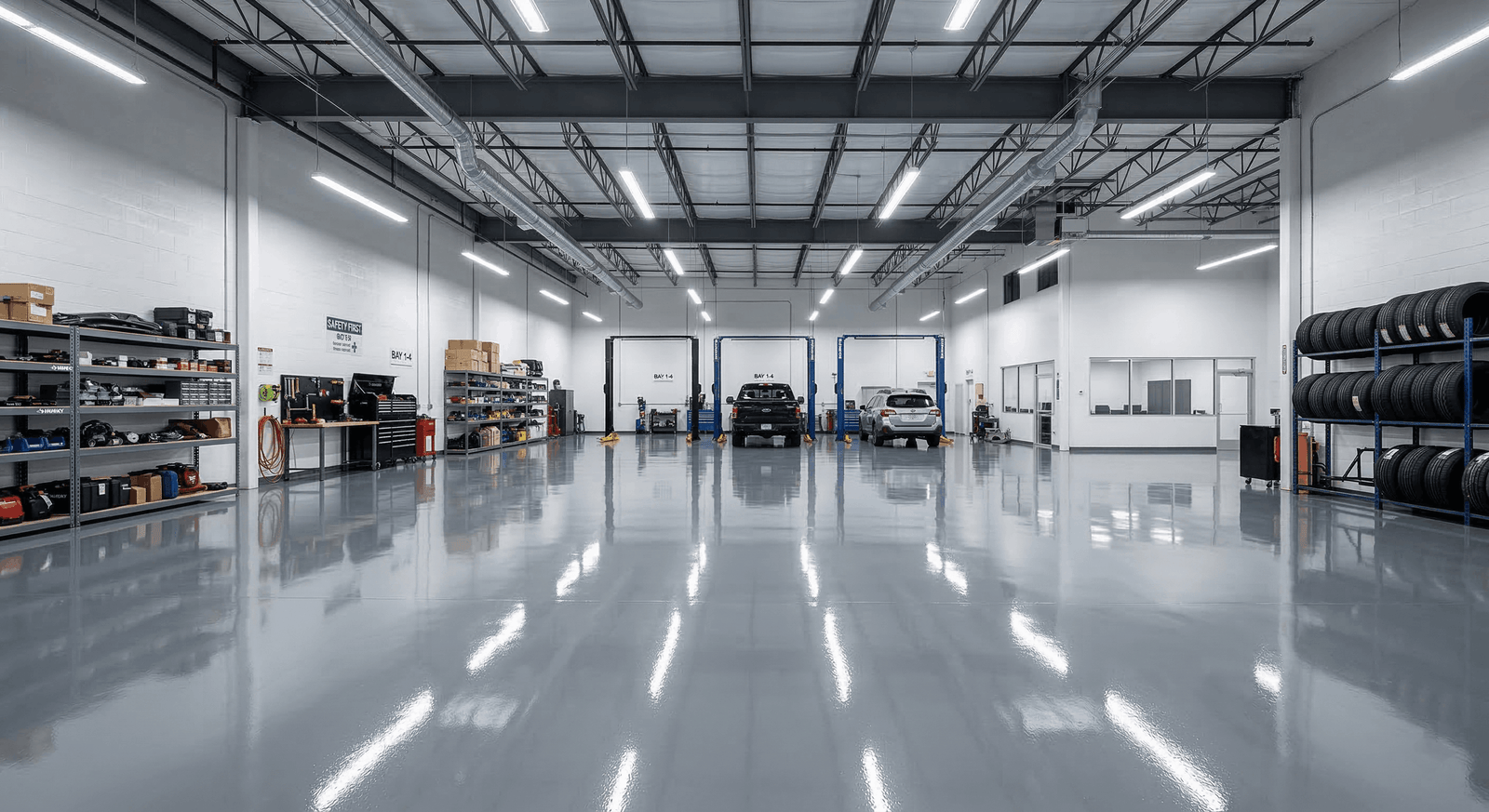
Industrial Floor
Coatings
Built To Spec
Industrial floor coatings — thermal-shock, chemical and forklift-rated systems, installed to written mil thickness
We install industrial floor coatings specified around what actually happens on a plant floor — caustic washdown, steam cleaning, thermal cycling, hard-wheel forklift traffic, and a production schedule that will not tolerate a week of downtime. The floor is a process asset, and we spec it like one.
Nearly every industrial floor coatings failure is a specification failure
We get called to look at a lot of failed industrial floor coatings. Almost none of them failed because the product was bad. They failed because someone specified the wrong system for the conditions, or specified the right system and never wrote down how thick to lay it. Three causes account for most of what we see, and all three are measurable before anyone opens a pail.
The slab was pushing moisture. Concrete poured without a vapor barrier — which describes most industrial slabs older than about 1990 — moves water vapor upward continuously. Put an impermeable film over it and that vapor collects at the bond line until it lifts the coating off in sheets. It is entirely predictable from an ASTM F2170 in-situ relative humidity probe, which needs a 24-hour equilibration under the current revision of the standard and costs almost nothing. Skipping it is how a $60,000 floor becomes a $60,000 mistake.
Prep was chemical, not mechanical. Acid etching is fast, cheap, and leaves both residue and an inconsistent profile. It is the shortcut behind most of the peeling industrial floor coatings we are asked to replace. Diamond grinding or shot blasting to an ICRI CSP 2–3 profile for thin systems, and CSP 5 or better under a mortar, costs more and is the difference between a coating that is bonded and one that is merely resting on the concrete.
Nobody wrote down the thickness. "High-build epoxy" is not a specification, it is a category. Without a stated wet and dry film thickness per coat, the installer's incentive is to spread the material as far as it will go, and a 30 mil system quoted honestly loses every time to the same system applied at 12 mil. Ask for mils in writing and half the bids will change. There is more on reading a bid line by line on our contractor selection page.
Reference Spec for Industrial Floor Coatings
Reference build- Surface prep
- Diamond grind or shot blast to CSP 2–3, joints and spalls repaired
- Moisture
- ASTM F2170 RH probe; vapor mitigation primer above 80% RH
- Primer
- 100% solids epoxy, penetrating, 6–8 mil
- Body coat
- High-build 100% solids epoxy, 20–25 mil
- Topcoat
- Aliphatic urethane or polyaspartic, chemical resistant, 6–10 mil
- Total build
- 30–40 mil nominal
- Wet areas
- Urethane cement mortar, 1/4 in, thermal-shock rated
- Slip resistance
- Aluminum oxide broadcast, tuned per zone
- Markings
- Aisles, walkways, racking limits, fire lanes coated in
- Return to service
- Foot 6 hr · Forklift 24 hr (polyaspartic build)
Industrial floor coatings, system by system
Industrial Epoxy Flooring
Highest build per dollarHigh-build 100% solids epoxy at 20–25 mil under a chemical-resistant urethane topcoat. The workhorse for dry-process manufacturing, assembly, and any floor that takes abrasion and spills daily. Best resurfacing value on a rough or previously coated slab.
ESD & Static Control
Electronics · Solvent handling · PowderConductive and static-dissipative systems over a grounded copper grid, characterized to ANSI/ESD STM7.1 resistance ranges after cure. Required wherever ESD-sensitive assemblies are open, solvent vapor is present, or combustible dust is handled.
Urethane Cement
Thermal shock · Washdown · USDA areasA cementitious urethane mortar whose thermal expansion nearly matches concrete, so it survives steam cleaning and hot washdown that would pop an epoxy straight off the slab. The correct answer in food, beverage and wet-process areas, and the one most contractors do not offer.
Polyaspartic Coating
Fast cure · 1-day return to serviceCures in hours instead of days and applies down to 0 °F, so an unheated bay in February is still a workable window. The answer when the line cannot be down for a week and every idle shift has a number attached to it.
MMA Resin Flooring
One-hour cure · Freezer installMethyl methacrylate cures hard in about an hour and goes down at temperatures well below freezing, which nothing else we install will do. The trade is a sharp monomer odor during cure that has to be planned around occupancy.
Slip-Resistant Systems
Wet zones · Oil · Drip linesAggregate broadcast sized and zoned to the hazard rather than sprinkled across the whole slab. Heavier texture where liquid lands, smoother where a scrubber has to clean it, and a written rationale for both.
Sealers & Densifiers
Dust control · Budget buildsThe lightest option: lithium silicate densifiers and thin-film sealers for storage bays and low-traffic areas where the real complaint is dusting rather than chemical attack. We will tell you honestly when this is enough.
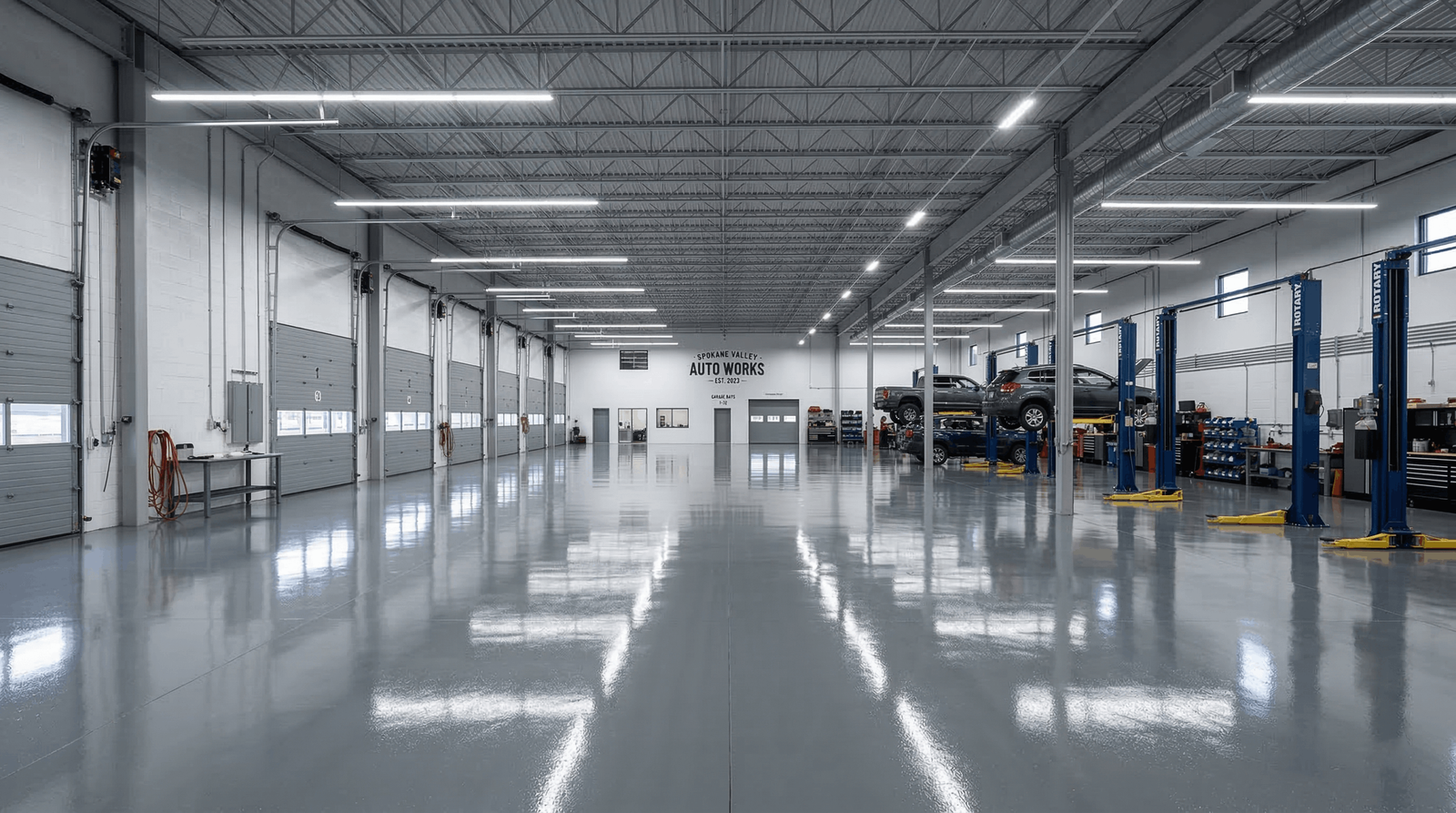
Thermal shock is the failure nobody quotes for
Chemical resistance gets all the attention on a data sheet, and it matters. But the failure mode that actually destroys industrial floor coatings is thermal, and it barely appears in most bids.
Epoxy expands and contracts at roughly three times the rate of concrete. On a dry floor at stable temperature that is irrelevant. Introduce a 180 °F washdown onto a 60 °F slab and the film tries to move while the concrete does not — the bond line takes the whole strain, and after enough cycles it lets go. This is why epoxy fails in breweries, dairies and freezer rooms while performing perfectly two hundred feet away in the dry warehouse.
Urethane cement solves it by having a coefficient of thermal expansion close to concrete's. It costs more per square foot and it is worth every cent in a wet-process area. If a bidder quotes epoxy for your washdown zone, they either have not asked what happens in that room or they only sell one thing.
- Caustic, acid and solvent resistance matched to the actual spill list
- Urethane cement where steam or hot washdown cycles the slab
- Novolac epoxy for aggressive acid and solvent exposure
- Chemical-resistance data supplied per product, in writing, before you sign
- Cove base, containment curbs and trench detailing
Your plant is revenue. We schedule around it.
A production floor sitting idle is not a scheduling inconvenience, it is lost output with a dollar figure attached. We schedule the way you plan a shutdown: phased zones, a written cure schedule, and a return-to-service commitment that goes in the contract. Our installation process lays out every step of it.
Polyaspartic chemistry is what makes a single-shift turnaround possible. Foot traffic in four to six hours, forklift traffic at twenty-four, against seventy-two hours or more for conventional epoxy. It also cures in the cold, so an unheated bay in January is a real option rather than a spring wait. Where the room is a freezer that cannot be warmed at all, MMA takes over.
- Zone-by-zone phasing so production never fully stops
- Night, weekend and shutdown-window crews
- Return-to-service milestones written into the scope
- Cold-weather application down to 0 °F with polyaspartic
- Dust-controlled grinding with HEPA shrouds near live lines
- Site safety orientation, LOTO awareness and confined-space coordination
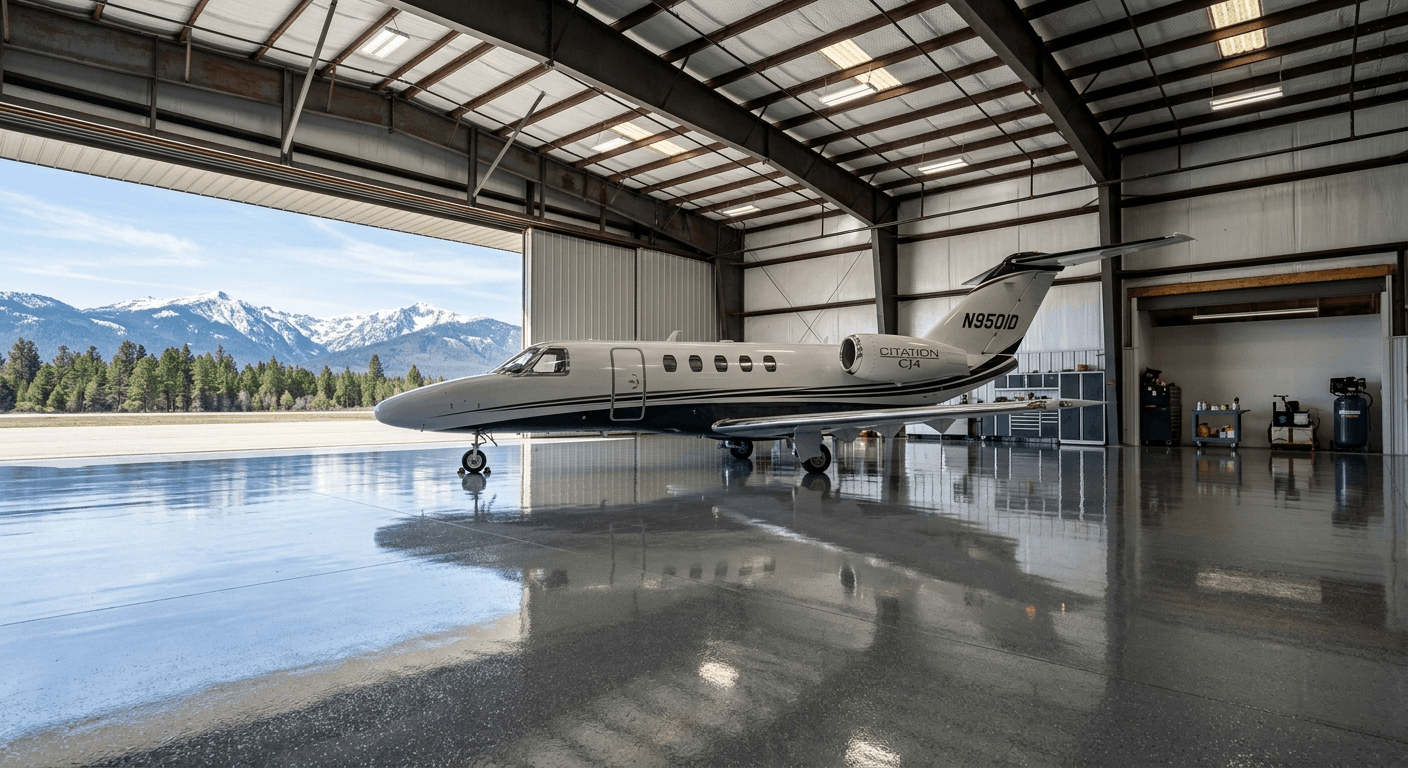
Six reasons these industrial floor coatings outlast the last ones
Industrial floor coatings fail for boring, preventable reasons. These six are how we design those failures out before they are priced in.
We test the slab before pricing it
Relative humidity probes per ASTM F2170, a bond pull test, and a look at your joints. Most industrial floor coatings fail on moisture, and moisture is measurable a day before anyone quotes.
Mechanical prep, never acid etch
Diamond grinding or shot blasting to an ICRI CSP 2–3 profile, deeper under a mortar system. Acid etching leaves residue and an inconsistent profile — it is the cheap shortcut behind most peeling industrial floors.
Mil thickness in the contract
We state wet and dry film build per coat and we hit it, checked with a comb gauge while the coat is still wet — the only moment the number is verifiable at all.
We carry more than one chemistry
Epoxy, urethane cement, polyaspartic, MMA, novolac and conductive systems. A contractor who only installs epoxy will recommend epoxy for your washdown room, because it is that or lose the job.
We install around production
Shutdown windows, night shifts, phased zones and live-line dust control. Site orientation, COI and safety documentation handled before we mobilize rather than at the gate.
Backed by a real company
Industrial Floor Coatings is a service of Crimbo Coatings — a licensed and insured, Google Guaranteed coatings contractor and a Sherwin-Williams certified installer. More about who we are.
Industrial floor coatings, from a single machine bay to a whole plant
Industrial concrete floor coatings are not one product. Chemistry, build and downtime tolerance all change with the process running above them, so industrial floor coatings get specified room by room. These pages go into the requirements specific to each.
Manufacturing & Plant
Assembly, machining and general production — abrasion, coolant and hard-wheel traffic.
IndustryFood & Beverage
Washdown, thermal shock and what FSIS inspectors actually look at. Where urethane cement earns its cost.
IndustryBrewery & Winery
Organic acids, caustic CIP, hot water and keg traffic on a permanently wet floor.
IndustryPharma & Lab
Seamless integral cove, disinfectant resistance and low-odor installs in occupied buildings.
IndustryChemical & Wastewater
Secondary containment, acid resistance and novolac systems for aggressive exposure.
IndustryAutomotive & Fleet
Service bays, lifts and wash areas — hot tire pickup, brake fluid and road salt.
Two things worth reading first
Both of these exist because we answer the same questions on every assessment call, and because most of what is written about industrial floor coatings online is aimed at residential garages rather than plants.
What It Costs
Cost per square foot by system, what moves the number, and why the cheap bid is usually the thin bid.
GuidePolyaspartic vs Epoxy
A straight comparison with a decision table, written for facilities rather than garages.
GuideChoosing a Contractor
What a real bid contains, the red flags, and how to line three quotes up against each other.
Industrial floor coatings, answered
Most industrial floor coatings land between $4 and $10 per square foot installed. A sealer or thin-film program on sound concrete runs $3 to $4.50. A full-build epoxy system with a urethane topcoat runs $5.50 to $8. Urethane cement for thermal shock and washdown runs $9 to $14, and static-control systems $8 to $12. Slab condition drives more of the number than the product does — heavy oil saturation, spalling, or a missing vapor barrier all add prep before any resin goes down. The cost guide breaks it down line by line.
Almost always moisture, prep, or film thickness — rarely the product itself. A slab without a vapor barrier pushes moisture up until it lifts the coating off, and that is measurable in advance with an in-situ RH probe. Acid etching instead of mechanical profiling leaves residue and an inconsistent surface. And a system quoted without a stated mil thickness gets applied as thin as it will spread. All three are specification failures, and all three are avoidable for less than the cost of doing the floor twice.
Epoxy is rigid, bonds chemically to concrete and excels at abrasion and chemical resistance in dry-process areas. Urethane cement is a mortar system whose thermal expansion is close to concrete's, so it survives steam cleaning, hot washdown and freezer cycling that would delaminate epoxy. In food, beverage and wet-process areas urethane cement is usually correct despite costing roughly twice as much. Anyone quoting epoxy for a washdown room has not asked what happens in it.
A conventional epoxy build needs 3 to 5 days on site plus 72 hours before forklift traffic and up to 7 days for full chemical resistance. Polyaspartic compresses that to a 1 to 2 day install with return to service at 24 hours, and MMA to a single shift. Most plant work gets phased zone by zone on nights and weekends so production never fully stops, and the return-to-service milestones go into the contract rather than being promised on the phone.
Yes, at the right build. Industrial floor coatings do not carry the load — the slab does — but they do have to survive the point pressure and torque of a hard polyurethane wheel pivoting in place. That takes 30 mil or more of high-solids build under a hard topcoat. A 5 mil rolled paint shears at exactly the pivot points, which is why failures always start in turning aisles and at dock approaches rather than out in the open floor.
Usually. Sound, well-bonded epoxy can be mechanically abraded and recoated, and that is the cheapest route to a new floor. Failing, delaminating or oil-saturated coatings have to come off first — recoating over a bad bond just buys you the same failure a year later, at your expense. We core and pull-test any previously coated slab before quoting.
More on industrial floor coatings cure schedules, containment, FSIS expectations and coating over existing floors on the full FAQ.
Send us your floor. We will send back a spec.
We spec off three things: the square footage, what happens on that floor, and how many shifts you can give up. You will get a written industrial floor coatings recommendation with mil thickness, cure schedule and a real number — at no cost.